
About the NZKF
Our Mission
To champion our budō arts (kendō, naginata, iaidō, jōdō) as providing new opportunities that are appealing and viable alternatives to mainstream physical activity in Aotearoa New Zealand.
To achieve this vision, we will focus on community-based budō and high performance budō in New Zealand.
Our community-based focus will be to provide cohesive and organised support to local dojos to enable the delivery of budō as an appealing and viable physical activity for a wide range of demographics. We will endeavour to support clubs to retain and develop club members.
Our high performance focus will be to develop teams of high performance athletes who can disrupt the status quo in the international arena.
Learn more about the NZKF’s vision to build New Zealand Kendo for the long term here.
Who Are We?
Board of Directors: Sue Lytollis (Chair), Alan Stephenson, Alex Bennett, Blake Bennett, Bruce Middleton, Shane Robinson. Secretary is Tasha Derrett.
Email – bod@kendo.org.nz
Secretary: – secretary@kendo.org.nz
Treasurer: Jing Lu – treasurer@kendo.org.nz
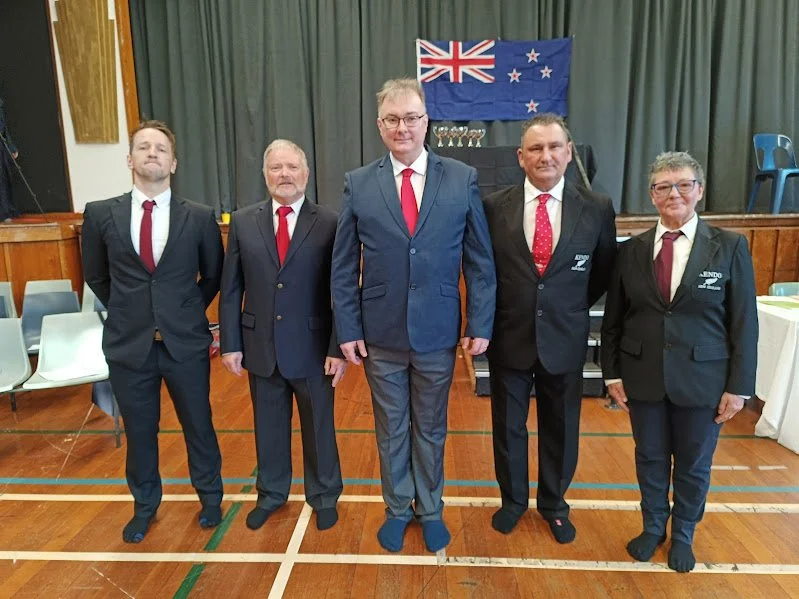
The NZKF Board of Directors (Minus Alex Bennett)
From left to right: Blake Bennett, Bruce Middleton, Shane Robinson, Alan Stephenson, Sue Lytollis.
Our History
A Brief History of the New Zealand Kendo Federation - Alex Bennett
The "All New Zealand Kendo Federation" officially came into being on September 20, 1976, when a Wellington solicitor named Gordon James Black registered its Rules with the Registrar of Incorporated Societies. Whether Black himself ever picked up a shinai is not recorded. His death notice describes him as a good man. He handled the registration of the fledgling federation.
Those registered Rules are the earliest document relating to the NZKF that has so far come to light. What came before is known only through recollection. The picture that emerges is consistent in its essentials. The NZKF was set in motion by two men from the United Kingdom, Tony Crawford and Steve Castle, both reportedly 2nd Dan who had trained at the Mumeishi Dojo in London. On arriving in New Zealand in the early to mid 1970s, they established clubs in different cities.
Crawford founded a dojo in Auckland, Seidokan, originally located on Albert Street. Castle established his base in Wellington, working in connection with an existing karate group run by John Jarvis, from which the Rembuden Kendo Club developed. These two centres, Auckland and Wellington, formed the earliest axis of kendo activity in New Zealand. There was also a less organised group in Christchurch.
By later accounts, early practice was somewhat improvised. It lacked firm connection to international structures and often blended elements that were not strictly orthodox kendo. Even so, Crawford and Castle laid the foundation of a national community. They linked practitioners across the two cities at a time when the art was virtually unknown in the country.
From these beginnings, a small but committed group of practitioners emerged. They formed the early backbone of the NZKF, which in 1976 formally came into being.
In Auckland, development was anything but linear. Seidokan became the initial centre of practice. By the mid 1980s, however, internal differences began to surface, along with shifting expectations about what constituted "proper kendo". Around 1985, a group of practitioners broke away and established a new club, Seiunjuku. Training was held at Auckland Girls' Grammar School under the guidance of Makoto Yonei, a Japanese 3rd Dan whose influence pushed practice toward a more orthodox Japanese style.
Others remained with Crawford at Seidokan. Further fragmentation followed. Additional groups formed, each small and often short on numbers. Among them was a club in West Auckland established by Ahjun Ahoy, loosely connected to Seidokan. At the same time, a separate stream led to the formation of Kenzenkan, created by Sue Lytollis and Carol Zerbe with members who had continued training at Auckland Girls' Grammar but had not joined Seiunjuku. Small groups trained on the same nights, sometimes with only a handful of members. It was enthusiastic, uneven, and typical of a young martial art finding its feet.
A turning point came in the mid 1980s. Graham Sayer, having spent several years training in Japan, began returning to New Zealand regularly. He was accompanied by Imasato-sensei, a Kyoshi 7th Dan who had been his teacher. Their visits brought technical direction and authority. Just as importantly, they brought a sense of coherence to what had been a fragmented scene.
New Zealand's development took place against the backdrop of an emerging international kendo structure. The International Kendo Federation (FIK) had been founded in 1970, the same year the first World Kendo Championships were held in Tokyo and Osaka. A New Zealand representative is recorded as having been present, although the details are unclear. By the 6th Championships in Paris in 1985, NZ fielded a team of three: Graham Sayer, Sue Lytollis, and Mike Hopley.
From that point, the NZKF has sent teams to every WKC. In 1988, New Zealand fielded a full team at the World Kendo Championships in Seoul. It was coached by Imasato-sensei and composed of members from both Seiunjuku and Kenzenkan. Shortly afterwards, it became clear that sustaining multiple small clubs in Auckland was neither practical nor beneficial. In 1989, Seiunjuku and Kenzenkan merged to form the Auckland Kendo Club. The result was a more stable and unified base for kendo in the region.
The federation's coaching structure took formal shape in 1998 with the appointment of Gerard Egerton as the first official National Coach. The role has since passed through several hands. Today, Dr Blake Bennett serves as Director of Coaching, overseeing high-performance kendo in New Zealand. NZ team members now train and compete internationally with regularity. Recent participation includes the Hong Kong Kendo Taikai and, in 2026, the inaugural Asia Oceania Kendo Federation Championships at the Tokyo Budokan where Max Lee of Rembuden won the Men's division up to 3rd Dan.
One figure who shaped the NZKF in its formative decades was Graham Sayer. New Zealand's first 6th Dan, he began his kendo in Kyoto and returned in 1986 to lead the Auckland Kendo Club. He served as President of the NZKF from 1987 until 2020, a tenure of thirty-three years. Ken Wells, the country's second 6th Dan and a fellow member of the Auckland Kendo Club, served alongside him as Vice President for many of those years and was later awarded life membership.
Over time, the NZKF brought within its remit all four internationally recognised disciplines: kendo, naginata, iaido, and jodo. In 2015, the original name was shortened to the New Zealand Kendo Federation Incorporated. Four years later, following a meeting of club leaders, the organisation underwent a structural overhaul. The positions of President and Vice President were replaced by an elected Board.
The inaugural Board faced immediate challenges. It had to navigate a new governance structure while contending with the COVID-19 pandemic. International competition was suspended. Regular training was disrupted. The effects lingered.
A second reorganisation in 2024 refined the structure further. Board elections are now held every three years, with members limited to two consecutive terms. The current Board, chaired by Sue Lytollis, is in its final year. Elections are due at the end of 2026.
Since the early 1990s, the NZKF has sustained a regular programme of national training camps and seminars. For many years, a Kendo Winter Camp was held over a weekend in August. Wellington hosted most of the early camps before a 2000 resolution distributed responsibility among clubs in different regions. These camps frequently drew visiting sensei from Japan and included grading examinations up to at least Shodan.
A Summer Camp, held each February, began in Nelson before moving to Auckland. It has since evolved into an International Seminar led by New Zealand's first Kendo 7th Dan, Dr Alex Bennett, with Takahashi Hideaki Hanshi 8th Dan and Fujiwara Hironobu Kyoshi 8th Dan. Alex recently established a dojo in Kyoto and serves as Vice President of the Asia Oceania Kendo Federation.
Individual clubs have also created events that now hold a place on the national calendar. In 2000, the Rembuden Kendo Club in Wellington hosted the first Poneke Challenge, the first internationally open kendo tournament in New Zealand. Now known as the Rembuden Kendo Taikai led by Martin Lee, it has been held annually, with the single exception of 2021. In 2005, South Island dojos established the South Island Kendo Championships. The North Island has likewise hosted its own championships, usually in Auckland, where the Auckland Kendo Club also holds the annual Inoue Hai in memory of Hanshi 8th Dan Inoue Yoshihiko.
As of May 2026, the NZKF encompasses kendo clubs in Auckland, Hamilton, Wellington, Nelson, Christchurch, Dunedin, and Invercargill, the southernmost kendo club in the world. laido dojos operate in Auckland, Palmerston North, and Wellington. Naginata is practised in Auckland, Wellington, and Dunedin. A fledgling Jodo dojo has also recently emerged in Auckland.
Fifty years on, the federation that Gordon Black registered on a September afternoon in Wellington has become a coherent community of around 300 people that spans two islands. It is held together by keiko, by shared standards, and by the quiet accumulation of effort across generations. What began as improvised practice has settled into something durable. Small, but steady, the NZKF continues to grow.
Contact us
If you’d like to get in touch with the NZKF, please submit the form below or email us at secretary@kendo.org.nz